The Sunrise Session: Why Dawn Workouts Convert Everyone Who Tries Them
Quick Answer: A sunrise workout gives you three things at once — air about 20°F cooler than late afternoon, an empty park, and the strongest available anchor for your body clock. Start with one session a week, not seven. Stage everything the night before so your 5:45am self makes zero decisions, and expect better sleep that same night as a side effect.
Nobody believes the sunrise-workout people until it happens to them.
Then you go once. Empty park. Cool air. The sky doing its slow, ridiculous performance while you finish a set. And you walk home at 7am with the entire day still ahead of you, quietly understanding the smugness.
It was never about discipline. It was about finding the loophole where summer, sleep, and solitude all pay out at once.

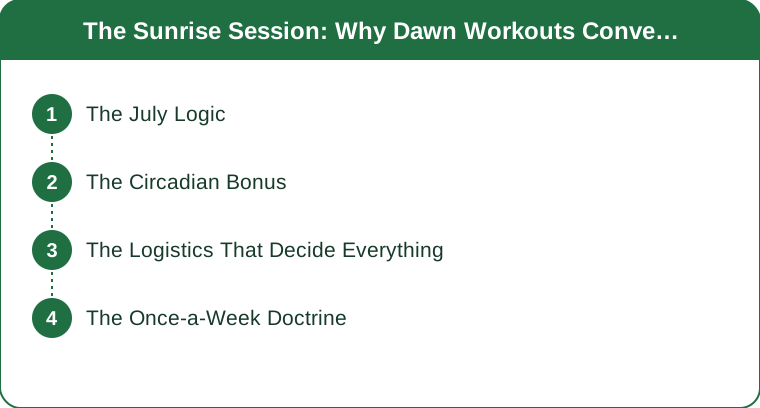
Why Is Summer the Best Time to Start Dawn Workouts?
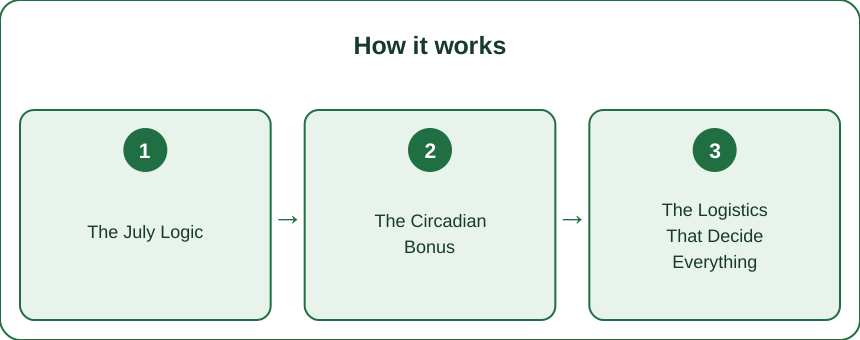
Summer makes dawn the only genuinely civilized outdoor slot.
The temperature math is brutal in your favor. A 6am start typically runs 15–20°F cooler than the same workout at 4pm. In a heatwave that’s not a comfort preference, it’s the difference between a workout you complete and one you abandon at the halfway point.
The air is better. Ground-level ozone and particulate levels are usually lowest in the early morning and peak in the afternoon heat. You’re breathing air that hasn’t been pre-processed by the entire city.
The crowds don’t exist. Trails, tracks, and outdoor gym equipment that are contested at 6pm are simply yours at 6am. No waiting, no negotiating, no headphones-as-social-armor.
If you’ve been quietly avoiding outdoor training all July because it’s unbearable, the problem was never the workout. It was the scheduling.
The Circadian Bonus Nobody Mentions
Here’s the part that surprises people: the sleep benefit is bigger than the fitness benefit.
Morning light — specifically bright light in the first hour or two after waking — is the strongest available signal for setting your body clock. It tells your system when “day” starts, which sets the timer for when melatonin releases roughly 14–16 hours later.
A dawn workout banks the exercise and the light exposure in one session. You’re not choosing between two health habits; you’re stacking them.
The practical effect most people notice: falling asleep more easily that same night. Two prescriptions, one alarm.
You don’t even need the sun fully up. Overcast dawn light is still dramatically brighter than any indoor lighting — a cloudy morning outdoors typically delivers more useful light than a well-lit room.

The Logistics That Decide Everything
The 5:45 alarm is won the night before. Every single time.
Stage the clothes. Laid out, in order, in the room you’ll be in. Not in a drawer. Not “I’ll grab something.” Your 5:45am brain will not make a wardrobe decision, and if it has to, it will make the decision to go back to bed.
Fill the water bottle. Put it by the door.
Write the plan down. One sentence. “3 miles easy” or “20 min bodyweight circuit, 4 rounds.” A sleepy brain follows arrows it laid down while it was smart. A sleepy brain does not design a workout.
Honor the bedtime. This is the whole thing, and it’s where the plan usually dies. A 5:45 alarm without a corresponding earlier bedtime isn’t a morning routine, it’s a sleep debt schedule. Count back 7.5–8 hours and treat that as a real appointment.
Put the alarm across the room. Old advice, still undefeated.
Coffee can wait until after. Momentum can’t — the gap between waking and moving is where the whole thing is decided, and it should be under five minutes.
The Once-a-Week Doctrine
Here’s where most sunrise-workout enthusiasm goes to die: someone tries it once, loves it, and immediately commits to doing it every day.
Two weeks later they’re exhausted, sleep-deprived, and have concluded that they’re “just not a morning person.”
One session a week delivers the entire experience at a sustainable cost. Saturday dawn plus weekday normalcy is the version that survives real life, work schedules, and the occasional late night that isn’t your fault.
If it becomes something you look forward to, add a second. If it doesn’t, one was still worth it — you got the empty park, the light exposure, and a genuinely good night’s sleep, roughly 50 times a year.
The sky performs weekly regardless. Attendance is flexible.
5 Mistakes Everyone Makes With Sunrise Workouts
- Going hard on the first session. Your body is cold, your joints are stiff, and your nervous system is still filing paperwork. Start easier than you would in the afternoon and extend the warm-up by five minutes.
- Skipping the warm-up entirely. Morning tissue is genuinely less pliable than afternoon tissue. Five to eight minutes of easy movement before anything intense isn’t optional.
- Committing to daily. See above. Weekly survives; daily collapses.
- Not adjusting bedtime. Waking earlier without sleeping earlier is just accumulating sleep debt with extra steps, and it’ll undo the benefit within a fortnight.
- Overcomplicating fuel. Most people are fine training fasted for a session under 60 minutes. If you’re not, a banana or a few dates 20 minutes before is enough. Don’t build a pre-workout ritual that adds 30 minutes to your morning.
What to Actually Do at 6am
Keep it simple, because complexity is friction.
Easy running or brisk walking, 25–40 minutes. The default, and hard to beat for the light-exposure benefit since you’re outside the whole time.
A bodyweight circuit, 20 minutes. Four rounds of squats, push-ups, lunges, and a plank hold. No equipment, no setup.
Mobility and a long walk, 30 minutes. The version for days when you’re tired but still want the light and the empty park.
Whatever you pick, wear something you don’t have to think about — a pair of leggings that stay put and a top that handles a temperature swing between 6am and 7:30am, because dawn is cool and it will not stay that way.
Mini FAQ
Is it better to work out at sunrise or in the evening?
For pure performance — strength and power output — late afternoon is genuinely slightly better, since core temperature peaks then. For consistency, air quality, crowd avoidance, and sleep quality, sunrise wins clearly. Most people get more total training done in the morning simply because fewer things can cancel it.
Should I eat before a sunrise workout?
For sessions under an hour at moderate intensity, most people are fine fasted. If you feel lightheaded or you’re doing something long or intense, a small carbohydrate snack 20–30 minutes before helps. If you have diabetes or any blood-sugar condition, talk to your clinician before training fasted.
How long does it take to adjust to waking up at 5:45?
Roughly one to two weeks if you shift your bedtime at the same time — and essentially never if you don’t. Move bedtime 15 minutes earlier every few nights rather than all at once, and keep the wake time consistent on weekends during the adjustment period.
TL;DR:
- Dawn is 15–20°F cooler, the air is cleaner, and the park is empty — summer’s actual scheduling answer.
- Morning light is the strongest body-clock anchor, so the workout improves that night’s sleep too.
- Stage clothes, water, and a one-sentence plan the night before. Zero morning decisions.
- Do it once a week, not daily. Weekly is the version that survives.
- Warm up longer, start easier, and move bedtime earlier or the whole thing unravels.
Stage the night, keep it weekly, collect the empty park and the sky’s opening act. The sunrise people were never more disciplined — they just found the loophole.
Keep Reading
This article is for general informational and styling purposes only. Fit, sizing, and product availability may vary.