How Far From a Busy Road Do You Need to Be to Train?
Quick Answer: Traffic-related pollution drops steeply within the first 50 metres of a road and approaches background levels somewhere between 150 and 500 metres, depending on wind and traffic volume. In practical terms: one block back from a main road removes most of the exposure. Timing matters nearly as much - avoid the peak of rush hour, since traffic pollutant concentrations follow traffic volume closely. And the headline finding is reassuring: for almost everyone, the benefits of exercising outdoors outweigh the pollution risk except in genuinely poor air quality.
This is one of the few environmental health questions with usable numbers attached, which means you can actually plan around it rather than just worrying about it.
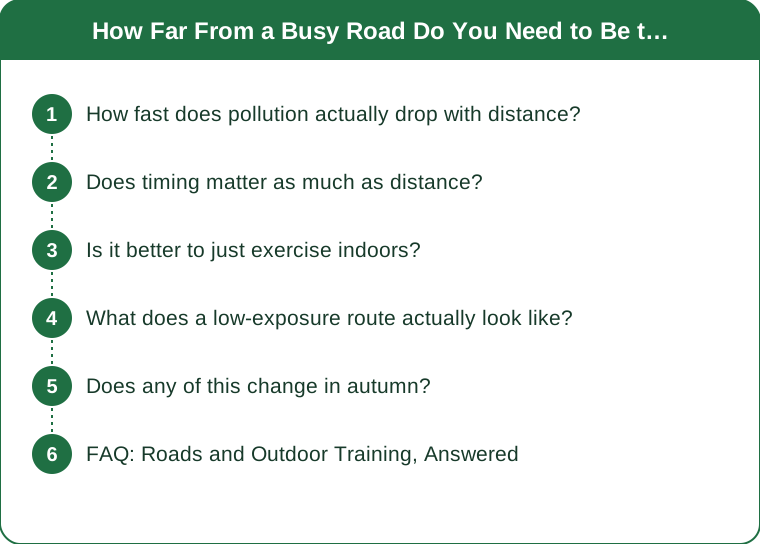
How fast does pollution actually drop with distance?
Faster than most people expect, and the shape of the curve is the useful part.
The consistent finding across roadside monitoring studies is a steep initial decline. Concentrations of traffic pollutants - ultrafine particles, nitrogen dioxide, black carbon - fall off sharply in the first tens of metres from the kerb, then flatten out.
Rough shape of it: the largest single reduction happens within about 50 metres. By 150 metres you are substantially closer to background. Depending on the pollutant, the traffic volume, and the wind, full return to background sits somewhere in the 150-500 metre range.
Ultrafine particles drop fastest because they coagulate and disperse quickly. Nitrogen dioxide persists further. Larger particulate matter is less dominated by local traffic in the first place.
The practical translation: in a typical town, one street back from a main road is a genuinely different environment. You do not need to find countryside. You need to find the parallel residential street, and that is usually a hundred metres away.
This is why two runners in the same neighbourhood can have substantially different exposures on routes that look nearly identical on a map.
Does timing matter as much as distance?
Nearly, and it is the easier variable to change.
Concentrations track traffic volume closely. Weekday rush hours produce the clear peaks, typically 7-9am and 4-7pm, with the morning peak often sharper because of atmospheric conditions.
The morning inversion is the complication. On calm clear mornings a temperature inversion traps pollutants near the ground overnight and into the early morning. So the 6am run that feels like it should have the cleanest air sometimes does not - the air has been sitting still and accumulating.
Mid-morning is frequently the best window. Traffic has dropped, the inversion has broken up with daytime heating, and photochemical ozone has not yet peaked.
Late afternoon is the worst combination in warm weather: evening traffic building on top of ozone that peaks in mid-to-late afternoon.
Wind is the single biggest modifier. A breeze disperses local traffic pollution quickly and shrinks the distance you need. Still, calm conditions are when roadside concentrations extend furthest.
The simple version: on a still weekday morning, get further from the road than you would on a breezy Sunday afternoon.
Is it better to just exercise indoors?
Usually not, and this is the part worth being clear about because the anxiety often outstrips the risk.
The research consistently finds that the benefits of physical activity outweigh the harms of air pollution for the large majority of people in the large majority of urban conditions. Modelling studies looking at cycling and walking in polluted cities keep reaching the same conclusion: the tipping point where pollution outweighs the benefit sits at concentrations far above what most cities experience most days.
Two genuine caveats.
Ventilation rate rises with intensity. You breathe more air, more deeply, and more of it through the mouth rather than the nose - bypassing nasal filtering. So a hard interval session directly beside a road is a meaningfully different exposure from a walk on the same pavement.
Individual susceptibility varies. Asthma, COPD, cardiovascular disease, pregnancy, and age at either end all shift the calculation. If you are in one of those groups, check air quality before hard outdoor sessions and take the advice of whoever manages your condition.
Indoor air is not automatically better. Gyms have their own issues, and indoor concentrations track outdoor ones with a lag unless there is proper filtration.
This is general information, not medical advice.
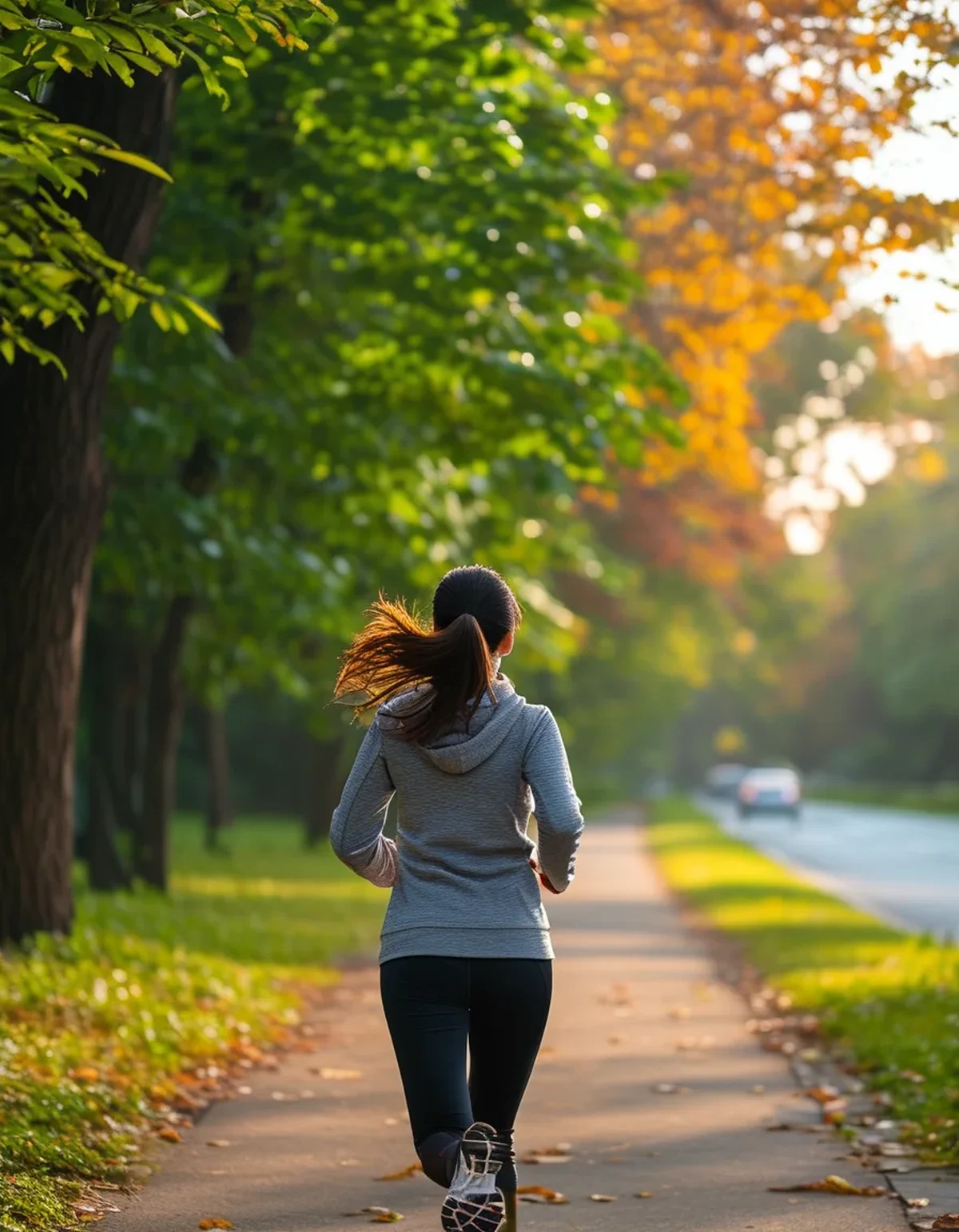
What does a low-exposure route actually look like?
Five features, and most neighbourhoods can supply three of them.
One block back from any arterial road. The single highest-value change and usually the easiest.
Crossings, not corridors. Crossing a busy road is a brief exposure. Running along one for two kilometres is not. Design routes that cut across traffic rather than parallel to it.
Avoid the worst micro-spots. Traffic lights, bus stops, and hills where vehicles accelerate are local concentration peaks - idling and acceleration both produce more emissions than steady cruising. A junction is worse than a stretch of open road at the same distance.
Upwind, if you can tell. On a windy day the side of the road the wind is coming from is noticeably cleaner. A quick look at which way the leaves are moving is enough.
Vegetation helps, with a caveat. A hedge or a row of trees between a path and a road reduces exposure. But dense tree cover over an enclosed street canyon can trap pollutants, so a tree-lined narrow road with buildings both sides is not the win it appears to be. A barrier between you and the traffic is good; a canopy over the traffic is not.
Does any of this change in autumn?
Yes, in three ways that matter for the next couple of months.
Inversions become more common. Cool clear nights with light wind produce the conditions that trap pollution near the ground, and these increase from September onward. The early morning run gets relatively worse through autumn compared to summer, when convection breaks the inversion earlier.
Traffic patterns shift back. The school run returns, holiday absences end, and weekday peaks sharpen noticeably from early September. If your usual route was fine in August, it is worth re-checking in the second week of September.
Ozone falls, particulates rise. Ozone is a summer problem driven by sunlight and heat; it drops away as the season turns. Particulate matter moves the other way, especially where there is domestic wood burning - and that becomes a genuine local factor on still evenings from October.
The practical adjustment: as the mornings cool, shift the harder outdoor sessions later - mid-morning rather than dawn - and keep the dawn slot for easy running where ventilation rate is lower. Check an air quality index on still, clear, cold mornings specifically; those are the days it is most likely to matter.
FAQ: Roads and Outdoor Training, Answered
What air quality number should make me train indoors?
Most guidance suggests reducing prolonged or heavy outdoor exertion when an index moves into the unhealthy-for-sensitive-groups band, and for everyone above that. Easy walking remains fine considerably higher.
Do face coverings help while running?
Cloth and surgical coverings do very little for the fine and ultrafine particles that matter here. Properly fitted respirators do, and they meaningfully impede breathing during exercise. Changing route and timing achieves more.
Is cycling in traffic worse than running beside it?
Cyclists are often in the traffic stream rather than beside it, which raises exposure, but they are also there for less time per kilometre. The research generally still favours cycling over driving on net health outcomes.
Does running behind a bus really matter?
For those seconds, yes - exhaust plumes are extremely concentrated locally. It is a short exposure and easy to avoid. Drop back or cross over.
TL;DR:
- Pollution falls steeply within 50 metres of a road and nears background by 150-500 metres - one block back does most of the work.
- Time matters nearly as much as distance. Avoid rush hour; mid-morning is often the cleanest window.
- Junctions, bus stops, and uphill stretches are local peaks - accelerating traffic emits more.
- The benefits of exercising outdoors outweigh the risk for most people in most conditions.
- Autumn brings more morning inversions - shift hard sessions later as the mornings cool.
This is one of the rare environmental worries with a straightforward fix. Move your route one street over and you have solved most of it.
Keep Reading
This article is for general informational and styling purposes only. Fit, sizing, and product availability may vary.