Same Workout, Better Mood: The Green Exercise Effect Explained
Quick Answer: “Green exercise” is the finding that identical workouts done outdoors produce better mood outcomes than the indoor version — lower perceived exertion, bigger mood and self-esteem gains, and higher intention to repeat. The dose-response research suggests benefits begin within the first five minutes. The practical move: swap one indoor session a week for the same session outside.
Exercise researchers kept running into an odd result. The same workout — matched for duration, intensity and effort — scored differently on mood questionnaires depending on where it happened.
Outdoors won. Repeatedly.
They named it green exercise, and the most useful part of the finding is how quickly it kicks in. Here’s what the effect is, and how to collect it without redesigning your training.

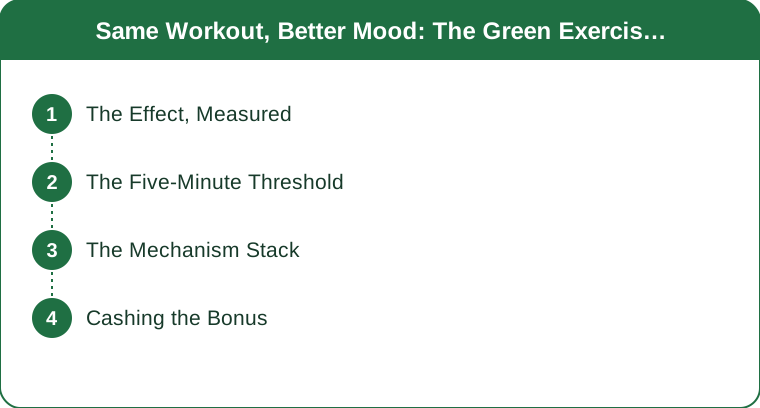
What Does the Green Exercise Research Actually Show?
Three findings turn up consistently in matched indoor-vs-outdoor comparisons:
Lower perceived exertion. The same effort feels easier outside. Participants working at identical measured intensity report the outdoor session as less hard — which means you can do slightly more, or the same amount with less dread.
Bigger mood and self-esteem gains. Both indoor and outdoor exercise improve mood; outdoor does more. Effects on tension, anger and depression scores tend to favour the outdoor condition.
Higher intent to repeat. This is the sleeper finding and probably the most important one. People say they’re more likely to do it again — and adherence, not any single session, is what actually produces results over a year.
Honest framing: these are mostly modest effect sizes from studies with small samples and self-reported mood outcomes, and “outdoors” covers everything from a city park to a mountain trail. It’s a reliable nudge, not a transformation. But it’s free, and there’s no obvious downside.
Why Does Five Minutes Matter So Much?
Because it removes the excuse.
The dose-response work on green exercise found mood benefits appearing within the first five minutes of activity, with the curve front-loading heavily — the biggest gain per minute happens right at the start, then flattens.
The practical implication is significant: a ten-minute park loop collects a real payment. You do not need a 90-minute trail run to get the mood effect. You need to get outside and move for a bit.
That reframes a lot of failed intentions. The barrier to outdoor exercise is usually logistics — changing, travelling, weather, time — and if the threshold is ten minutes rather than an hour, most of those barriers shrink to nothing.
Perfectionism about duration was never required, and here it’s actively counterproductive.

What’s Actually Causing the Effect?
Nobody has isolated a single mechanism, which is normal for this kind of finding. Four plausible contributors stack:
Attention restoration. The theory holds that natural environments engage attention softly — leaves, water, changing light — which lets the directed-attention system that your job exhausts recover. A treadmill facing a wall does the opposite.
Sunlight. Outdoor light is orders of magnitude brighter than indoor lighting, even on a cloudy day. Morning light exposure supports circadian rhythm, which affects sleep, which affects mood — a longer causal chain but a real one.
Sensory variety. Temperature shifts, moving air, uneven ground, changing sound. Your nervous system gets varied input rather than a constant one.
Novelty. The trail updates itself. The treadmill never does. Boredom is a genuine adherence killer and outdoor routes solve it passively.
All four are available in an ordinary city park. You don’t need wilderness — the research includes plenty of unglamorous urban green space.
What Nobody Tells You About Taking Workouts Outside
Blue counts too. Water — rivers, lakes, coast — shows up in the research alongside green space, sometimes with comparable effects. A canal path is a legitimate venue.
Cold weather doesn’t cancel it. Winter outdoor sessions still produce the mood benefit, and the light exposure matters more in winter, not less. Dress for it and the barrier is clothing, not season.
You’ll go slower outside, and that’s fine. Uneven ground, hills, wind and traffic lights mean your pace won’t match the treadmill. Comparing the two numbers is how people talk themselves back indoors.
Group outdoor exercise stacks two effects. Green exercise plus social contact both independently support mood. A weekly walk with someone is quietly one of the highest-return habits available.
It doesn’t replace treatment. The mood effect is real and worth having, but it’s a supportive habit, not a therapy. Exercise is genuinely useful for mild-to-moderate low mood; it isn’t a substitute for professional care when that’s needed.
How Do You Cash the Bonus?
Move one indoor session outside, weekly. That’s the whole intervention. Same programming, different venue.
The easy conversions:
- Treadmill walk → park walk. Direct swap, zero adjustment.
- Mat routine → grass or a picnic blanket. Yoga, mobility, core work all travel fine.
- Weights day → bench circuit. Step-ups, dips, incline push-ups, split squats, carries with whatever you brought.
- Intervals → hill repeats. A single hill replaces the treadmill’s incline function entirely.
- Cooldown only. If nothing else works, do your warm-up and cooldown outside. Ten minutes, two payments.
Keep it low-friction: pick a route within five minutes of your door, keep shoes by the door, and decide the night before. The gym keeps its place. It just loses its monopoly.
When to see a professional: persistent low mood lasting more than two weeks, loss of interest in things you normally enjoy, or sleep and appetite changes are worth discussing with a doctor. Outdoor exercise supports mental health; it doesn’t diagnose or treat depression.
Is exercising outside better than the gym?
For mood outcomes, the research consistently favours outdoors — lower perceived exertion, better mood gains, higher intent to repeat. For heavy strength training, controlled loading and equipment access, the gym wins. Most people are best served by using both.
How long do you need to exercise outdoors to feel better?
Benefits appear to begin within the first five minutes, with the biggest gains front-loaded. A ten-minute outdoor walk delivers a genuine mood benefit — you don’t need a long session to collect most of it.
Does walking in a city park count as green exercise?
Yes. Much of the underlying research uses ordinary urban green space rather than wilderness, and water settings show similar effects. Access, not scenery quality, is the main variable that matters.
TL;DR:
- Matched studies find outdoor workouts beat indoor on mood, perceived exertion and intent to repeat.
- Benefits start within the first five minutes — the effect front-loads.
- Likely mechanisms: attention restoration, sunlight, sensory variety, novelty.
- City parks and waterside paths count. You don’t need wilderness.
- Swap one indoor session a week — treadmill to park, mat to grass, weights to bench circuit.
- Adherence is the real prize: the workout that feels good is the one you keep doing.
Keep Reading
This article is for general informational and styling purposes only. Fit, sizing, and product availability may vary.